Removal method
Biochar Biomass Removal + Storage (BCR & BiCRS)
Our carbon removal portfolios include biochar and biomass removal and storage (BiCRS) that turns waste plants into a stable carbon removal solution.
Our carbon removal portfolios include biochar (BCR) and biomass removal and storage (BiCRS). It takes waste plant-based feedstocks which would have decomposed and released carbon back out, stabilize it with a process called pyrolysis to store the carbon for hundreds to thousands of years.
How does it work?
Biochar takes a carbon releasing feedstock - organic things like farm waste - and puts it through a process that removes that carbon from the wider environment in a durable way. This means it can't easily be re-released into the atmosphere to contribute to climate change.
The waste biomass is heated to a particular temperature in a low oxygen environment which means it doesn't burn. This process means it won't rot. The carbon cannot be re-emitted and can't contribute to climate change. Uses include spreading it on cropland to replace fertilizers, burying it or as a feedstock to make other materials that could replace fossil fuel plastics.
Why do we like it?
It's more permanent than storing carbon in trees. In the right conditions, biochar has the potential to safely store carbon for 1000 years or more. The duration depends on what happens to the biochar once it's been made. In some scenarios it's durable for a thousand years.
An important co-benefit is that biochar can be used as a replacement to fertilizers to enhance crops and soils, or as a carbon negative replacement material to make things.
What's great about biochar is that we can scale it pretty quickly. It's a known and established process, and there are a load of providers already. Combine that with the huge amount of waste biomass around the world that could be used and it's a promising CDR solution. For more detail on how we choose solutions, check out our Carbon Removal Portfolio Methodology.
Our BCR Partners

We're excited to be working with Mash Makes, an Indo-Danish company. Headquartered in Denmark, Mash’s first operations are in India, where they are converting agricultural waste that otherwise would be burnt into biochar and energy solutions - they call this the Maharashtra model. They’ll soon have two plants operational, producing 30,000 tonnes/year, and are aiming for at least 50 more such plants over the next five years, with an annual potential for 1 million tCO2e CDR.
Their model includes remediating semi-arid soils in India, which will increase biomass and biodiversity, improve food security and provide new, green economic opportunities amongst other co-benefits. Mash’s Biochar is European Biochar Certificate (EBC) certified. Read more about Mash Makes.
We’ve been following Carboneer’s progress for a while and have been so impressed with their focus on creating carbon removal with deep co-benefits for the local communities they work with. Having delivered their first tonnes during 2023, a strong focus on verification, and with ambitious scaling plans makes them natural partners for us.
Carboneers develops decentralized biochar projects in the Global South by providing distributed farming communities with training, tools and technology to create biochar and carbon dioxide removal credits as a source of both income and an alternative organic fertilizer. Read more about the Carboneers' story, progress and ambitions.

We're thrilled to include Novocarbo. Based in Germany, they are using waste and residue feedstocks from sustainable European-based forestry management (which have the strictest regulations on biodiversity in the world). They are scaling up to tens of thousands of tonnes per year and aiming to double capacity every year.
The biochar they produce is used in agriculture to enhance soils and store carbon for hundreds of years. They also look to use their biochar in other applications, for example as a carbon negative alternative additive to concrete which would increase the permanence of the carbon removal to hundreds more years. Novocarbo follow the European Biochar Certification (EBC) standards. Read more about Novocarbo's story, progress and ambitions.
We're also exploring partnerships with additional biochar, BCR and BiCRS providers in different parts of the world, utilizing different waste feedstocks, approaches and end use cases. Further annoucements to follow!
Learn more + join our Carbon Removal Portfolio
Find out moreOur Carbon Removal Partners
Learn more by clicking on a partner to discover how the solution works and their company's progress.










Frequently Asked Questions
We love questions! We want you to feel 100% comfortable and excited about joining our Carbon Removal Portfolio. It's something we wished existed but couldn't find, so we made it!
- So the industry reaches about 10 billion tonnes of capacity by 2050 - the "net" bit of Net Zero
- The ratio of carbon removal in the Voluntary Carbon Markets needs to increase (compared to other approaches like avoidance or reduction)
- No one carbon removal type or company is going to be big enough on its own, we need a range of solutions and providers
- When combined with reducing emissions from everything we do, carbon removal will be a key tool to slow and then reverse climate change
- Funding and investing in it now helps to reduce the cost per tonne it takes to remove the carbon. Decreasing the cost by increasing demand will support the growth in supply of high-quality carbon removal options and capacity volume.
Every tonne matters
Our ready-made, curated, portfolio of high quality carbon dioxide removal (CDR) solutions is live. It aims for the highest permanence-for-the-$-per-tonne that we can find.
We're excited to be working with an inspiring group of global CDR companies taking the fight to the Climate Crisis. They're doing amazing work that holds a tonne - pun intended - of promise.
Discover more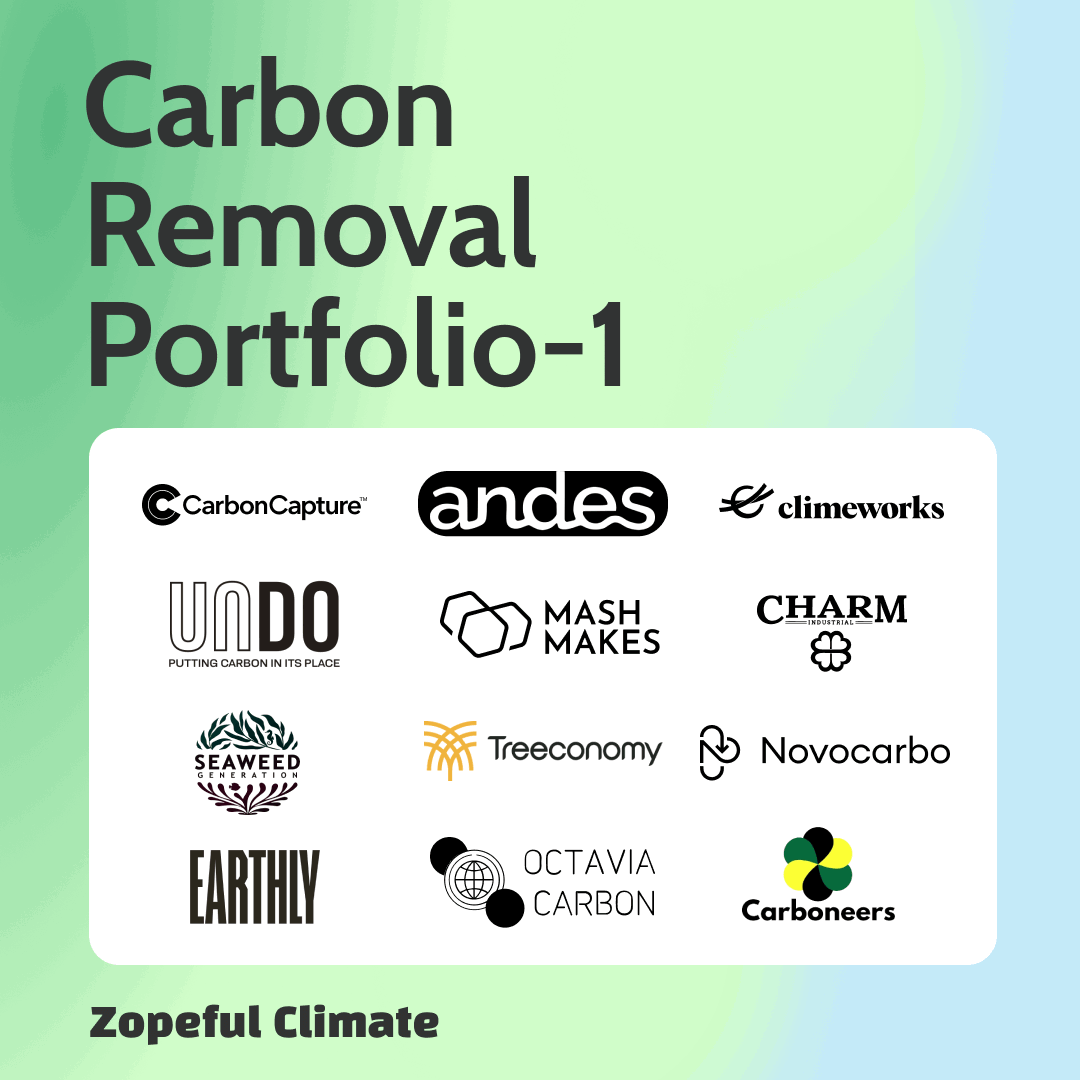
Together
Some stuff folks say about us
The methods
Every pathway in the portfolio
- 01Enhanced Rock WeatheringPutting boosters on the natural weathering cycle of basalt.See more →
- 02Direct Air Capture & StorageTaking CO₂ directly out of the air and mineralizing it deep underground.See more →
- 03Bio-oil & StorageTurning waste biomass into a high carbon, low energy liquid.See more →
- 04Oceans & CoastalUsing the ocean carbon sink to store more planet-heating emissions.See more →
- 05Nature-basedSupporting and developing land-based natural carbon sinks.See more →
- 06Soil Carbon RemovalBuilding carbon back into farmed and managed soils.See more →
Start removing carbon today
Our ready-made portfolio spreads your removal across every method on this list.